Labor and Climate Justice Education Committee
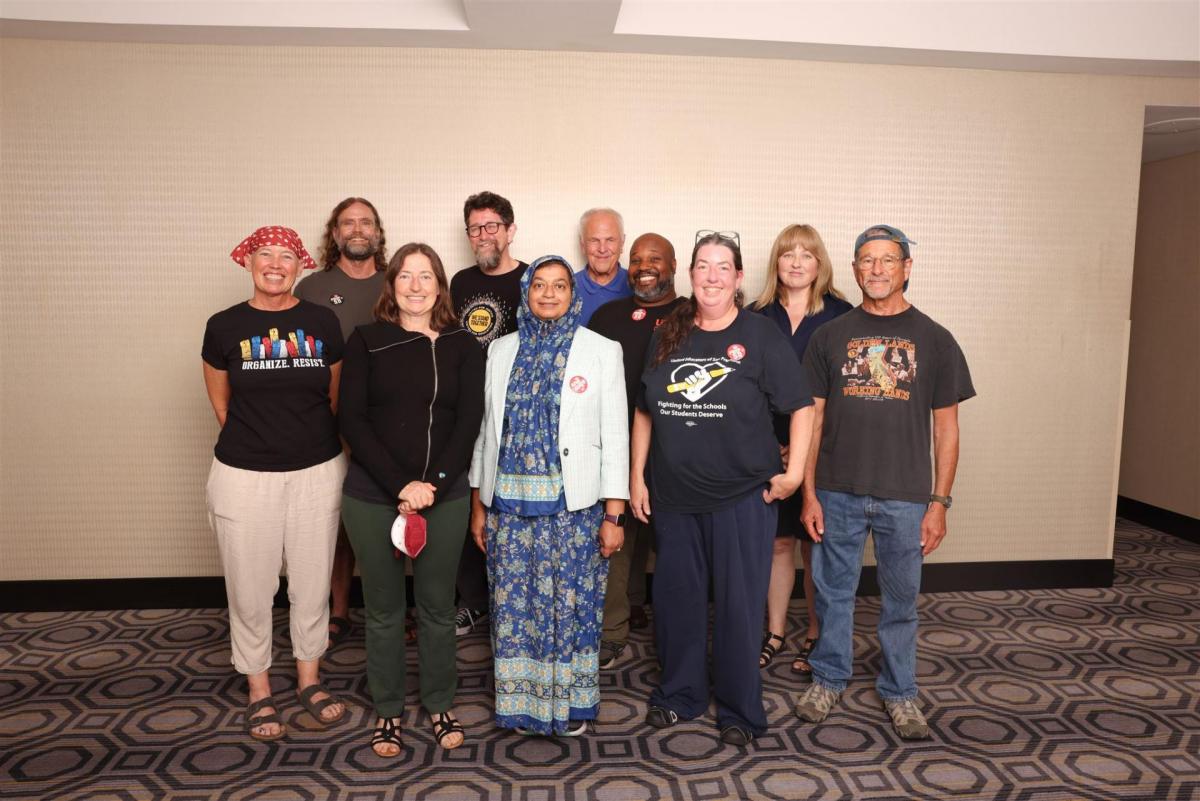
The Labor and Climate Justice Education Committee helps teachers reach students with information about the history and current place of the labor movement in American democracy. In recent years, the committee has begun addressing climate justice issues for members and students.
Committee members are classroom teachers, faculty from community college and university labor studies programs, and classified employees. The committee is available to assist educators in all aspects of teaching young people about the labor movement, and welcomes comments and suggestions about these topics.
PRIORITIES
- Track and monitor public education policy relating to teaching about labor and provide policy recommendations to CFT governance bodies.
- Produce materials and organize workshops about climate justice as related to the labor movement so as to ensure CFT locals have the information to be effective advocates locally.
- Produce lesson plans on labor and continue to promote these materials so that they can be widely used.
- Develop workshops for educators and unionists to give them access to CFT labor curricula materials and provide tips on teaching about labor.
- Track CFT’s proposed state Labor in the Schools pilot program. Monitor and assist with implementation, as needed.
- Oversee work on two long-term projects – Golden Lands, Working Hands and the Collective Bargaining Education Project.
PROJECTS
Critical Thinking about AI
In the next 10 years the AI education market is projected to reach between $112 billion and $127 billion — more than double the federal government’s entire K–12 education budget. Tech executives, administrators, and even some teacher union leaders are urging educators to utilize AI for everything from lesson planning to giving feedback, and to teach students how to use AI “ethically.”
Read more
AB 800 Workplace Readiness Week: Five Day Learning Cycle
Labor Curricula
The committee has developed lesson plans on labor for students at all levels of education, from preschool coloring books to college and university readings, to union-based new member orientation programs. These are free to download and for sale in print.
The committee’s newest labor video and curriculum is We Mean to Make Things Over: A History of May Day.
Climate Justice Toolkit
The committees’s newest project is a series of flyers about the CFT’s climate justice agenda that spells out what members can do to take action. Find our Climate Justice Toolkit here.
Golden Lands, Working Hands
This award-winning curriculum brings labor history alive for high school and college students. Golden Lands, Working Hands is a 10-part video series that originally aired on California PBS stations. Praised by educators, labor leaders, and students, Golden Lands Working Hands explores California history from the point of view of its working families. Available for purchase on DVD and streaming for free on Vimeo.
Collective Bargaining Education Project
The Collective Bargaining Education Project promotes understanding of how labor and management resolve workplace conflicts through the methods developed in collective bargaining negotiations. Using a simulation/role play method, the award-winning program brings lessons to high school students in the Los Angeles Unified School District and elsewhere. Committee member Linda Tubach can work with you to make these lessons happen in your classroom. Lesson plans are available here.
May is Labor History Month and Safe Jobs for Youth Month
In 2012, Gov. Jerry Brown signed legislation that established Labor History Month with the intent of encouraging schools “to commemorate this month with appropriate educational exercises that make pupils aware of the role the labor movement has played in shaping California and the United States.” The CFT and the California Labor Federation co-sponsored AB 2269 (Swanson, D-Oakland).
The Labor and Climate Justice Education Committee works with friends in the Legislature and the labor movement to carry out the spirit of the law by disseminating information and instructional materials.
May is also “Safe Jobs for Youth” month. Committee members collaborate with the Young Workers Project at UC Berkeley to help publicize this valuable resource, which includes curricula for educators. Learn about what you can do in your community to educate and protect working teens, parents and employers on ‘Safe Jobs for Youth Month’.
Teaching Taxes
Few things cause more emotion in politics than taxes. Yet the purpose of taxes is simple: to provide the revenues so that government can function for the people. Taxes pay for parks, transportation, roads, bridges, unemployment insurance, the Affordable Care Act, Social Security, the military: the list is long, and the feelings about each program vary from person to person.
But there can be no doubt about the necessity of some form of taxes to make society work.
The questions are: how much? for what purpose? and who is taxed?
Check out the teaching modules here: Teaching Taxes Modules
Members
Mayhew, Kelly, Chair, AFT Guild, San Diego and Grossmont-Cuyamaca Community Colleges
Baldiwala, Fatima, Los Angeles College Faculty Guild
Fefferman, Nicole, United Teachers Los Angeles
Glass, Fred, San Francisco Community College District Federation of Teachers
Hind, David, ABC Federation of Teachers
Horton, Jamaica, Lompoc Federation of Teachers
Killebrew, Ann, San Francisco Community College District Federation of Teachers, Retiree Chapter
Kyle, Wade, United Teachers Los Angeles
Lourie, Bethany, Berkeley Federation of Teachers
Maier, Mark, Glendale College Guild, Retiree Chapter
Mason, Susannah, United Educators of San Francisco
Miller, Jim, AFT Guild, San Diego and Grossmont-Cuyamaca Community Colleges
Rubino, Gabriella, Salinas Valley Federation of Educators
Shields, Bill, San Francisco Community College District Federation of Teachers, Retiree
Chapter
Tubach, Linda, United Teachers Los Angeles, Retiree Chapter
McCarthy, Nason, Staff Liaison, California Federation of Teachers